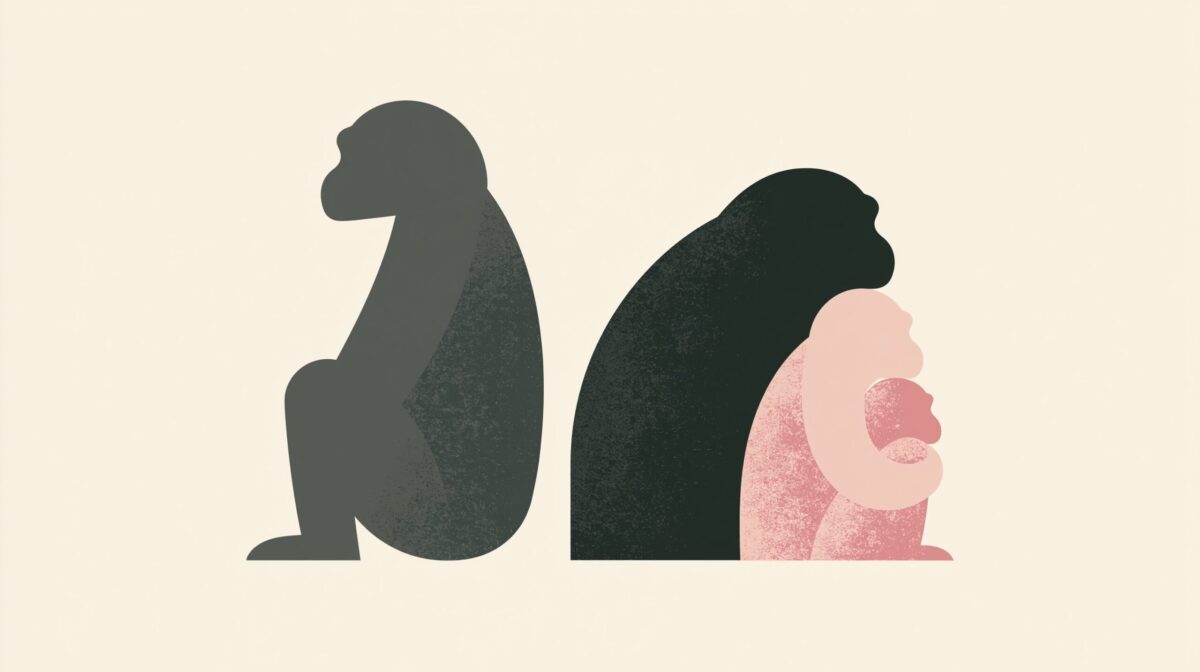
There's a prevailing argument or belief that says male dominance is natural, that hierarchy and violence are natural, that this is how primates work, we are primates, therefore any attempt to organise ourselves differently is naive at best.
But the person making this argument rarely means primates in general. They mean a specific story about primates — the aggressive male, the dominance hierarchy, the coalition of males enforcing access to food and mating and movement. They mean the chimpanzee, whether or not they know that's what they mean.
Let's examine this by starting with the animals.
Two pieces of research are useful here and they matter because both studies put a dent in the same assumption — that male dominance is biologically fixed. One looks at what happened when the most aggressive males in a baboon troop died. The other looks at how female bonobos hold power over males despite being physically smaller. One is a study in culture. The other is a study in coalition. Together they make “it's just nature” look a good deal less like science and a good deal more like politics.
The baboons who changed the room
Robert Sapolsky had been studying wild olive baboons in Kenya since the late 1970s when something both awful and scientifically striking happened.
In the mid-1980s, a tuberculosis outbreak killed roughly half the adult males in a troop known as Forest Troop. It wasn't random which males died. The most aggressive ones were also the ones most likely to leave their own range, force their way into a tourist-lodge rubbish dump, and fight for contaminated food. The less aggressive males took fewer risks, and so were more likely to survive them.
Under ordinary conditions, that kind of male aggression structures the whole atmosphere of the troop — low-ranking males get harassed, females get attacked, dominance gets reasserted constantly, in all the tiresome ways power likes to announce itself.
After the outbreak, Forest Troop changed. The surviving males were less aggressive. Grooming and affiliative contact between males and females increased. The dominance hierarchy relaxed, and low-ranking males stopped carrying the same chronic harassment in their bodies — later data showed subordinate males without the elevated stress-hormone levels usually seen in low-ranking animals. Their physiology, not just their behaviour, had changed.
It's been observed that male baboons leave their birth troop at adolescence and don't return. So by the early 1990s, the adult males living in Forest Troop weren't the males who'd survived the outbreak. Those males were gone. And yet the new males transferring in from other troops — troops that had never changed, that still ran on the old hierarchy — adopted the calmer local culture within their new home. Sapolsky and Lisa Share's 2004 paper documented the shift persisting a decade after the deaths; Sapolsky has since described it holding for years beyond that.1
If aggression were hard-wired, that should have snapped back the moment new males arrived carrying the old programming. It didn't. Something in Forest Troop taught incoming males a different set of rules through what got tolerated, who got groomed, who got proximity and acceptance and who didn't.
Culture, in other words, wasn't a human word being applied to animal behaviour. It was a measurable, transmissible social inheritance — one that outlasted every individual who created it. And if a baboon troop can pass down a less violent culture after the originating males are gone, hierarchy isn't a fact of nature after all. It's learned, maintained, transmitted, and under the right conditions, replaced.
The other close relative
Now let's look at the research on the apes.
Bonobos and chimpanzees are sister species, splitting from a common ancestor roughly 1.7 million years ago — recent, in great-ape terms — and both count among the closest living relatives of humans.
This is where “primates prove patriarchy” starts to wear thin, because chimpanzees and bonobos are not socially interchangeable. In chimpanzee societies, males generally dominate: they form alliances, compete for rank, and use aggression against both males and females, including in coercive mating. In bonobo societies, the pattern reverses. Females typically hold higher status than males, despite males usually being the larger of the two.
The interesting question isn't whether bonobos are the nice ones. They're not existing in some permanent state of emotional regulation — they can be aggressive, strategic, and thoroughly political. The better question is “How do female bonobos actually hold power?”
The mechanism is not magic
In 2025, Martin Surbeck, Barbara Fruth and their colleagues published a study in Communications Biology — “Drivers of female power in bonobos” — compiling thirty years of behavioural and demographic data across six wild bonobo communities.2 That's decades of field notes, tested against competing explanations.
The team weighed three possible drivers of female dominance: the compounding effects of winning and losing conflicts, reproductive control through synchronised sexual swellings, and coalition formation. Only coalition held up across the data. Females targeted males in 85 percent of their coalitions, and occupied higher rank relative to males the more frequently they formed them. The study's conclusion is plain: coalition formation is a behavioural tool females use to gain power over males.
It isn't size, or a male protector, or some permanent, species-wide state of goodwill. It's collective action.
This is also why “matriarchy” isn't the most useful word for what's happening here, however tempting it is to reach for the neat opposite of patriarchy. The word isn't the point — the mechanism is. Female bonobos don't need to out-muscle males individually to limit what those males can get away with. They organise, they intervene, and the coalition itself changes the cost of male aggression.
The study also closes off the usual ecological escape hatch — the idea that bonobo society is just a product of abundant food or an easy habitat. Ecology matters, but tested against the data, the strongest predictor of female power wasn't food abundance or the proportion of males in a group. It was female coalitionary aggression against males. If someone wants to wave this away as “bonobos just have more food,” the data doesn't support it.
One detail that gets glossed over whenever bonobo research does the rounds is that bonobos are known for frequent sex, and it's tempting to credit that generally for the calmer social order, or worse, to credit male-female sex specifically, as though male bonobos are simply too satisfied to bother with aggression. The data says otherwise. Female-female sexual contact occurs more often than male-female contact, and it's specifically after female-female contact that the trust, proximity and cooperation driving coalition show up — measurably, in hormone data and in shared access to food.3 Male-female sex doesn't carry the same signal. Whatever is producing this social order, it isn't happening “in the bedroom” between the sexes. It's happening between the females.
The missing half of the nature argument
When someone says male dominance is natural and gestures at “our primate relatives,” they are almost always citing the chimpanzee and leaving the bonobo out of the room, which points to selection bias. Both species are equally related to us, so if primate behaviour is going to be used as evidence for what humans can or can't build, you don't get to keep the species that confirms your bias and drop the one that doesn't.
Once both are on the table, biology doesn't say male dominance is inevitable. It says closely related species can organise power differently. It says aggression exists, but its direction and its consequences depend on social structure. It says dominance cultures can be transmitted, interrupted, and replaced. And it says coalition changes the cost of aggression. It doesn't say the difference comes down to a better individual temperament, or one exceptional female standing alone while everyone else watches from a safe distance. This is a position that women are still handed today.
No, humans are not bonobos
Before anyone reaches for the objection that humans aren't bonobos, or patriarchy isn't a big male ape with his chest out, we're not saying that. We're saying that it's law, money, religion, inheritance, unpaid labour, sexual violence, state power, workplace structure, and the thousand small permissions by which one half of the population is told to take up less room, then praised for managing it gracefully and punished for pushing back.
And if anyone still wants to treat patriarchy as a feminist mood rather than a material system, the World Bank's Women, Business and the Law 2024 report is useful here: women worldwide hold roughly two-thirds of the legal protections men do, and fewer than 40 percent of the systems needed to actually implement even those exist yet.4
So this isn't a one-to-one animal analogy. It's narrower than that, and sharper, removing the biological escape hatch.
Sapolsky's baboons don't prove human dominance systems will dissolve on their own if enough of the wrong men eat the wrong sandwich. What they show is that even in a famously male-dominated primate species, culture can change, and the new culture outlasts the animals who built it. Surbeck's bonobos don't prove women can fix male violence by being calmer, kinder, or more patient — another chore routinely handed to women whenever a society wants male behaviour managed without male power being challenged. What they show is that female power, in this dataset, tracks coalition. Not individual exceptionalism. Not waiting for the aggressive ones to die of tuberculosis, though the baboons suggest that helps.
Coalition. The repeated, unglamorous fact of females refusing to leave each other alone in the face of male aggression.
What nature actually says
The argument that dominance is ancient, therefore righteous; hierarchy is biological, therefore permanent; and violence is inevitable, therefore organising against it is childish — is not supported by science.
The baboons say culture can change, and the change outlasts the animals who started it. The bonobos say female power isn't a body size or a temperament, but a mechanism — coalition, repeated, until it changes what a male can get away with. And the bonobos say something narrower still. The trust and cooperation behind that coalition don't run through females' relationships with males, they run between females. Whatever produces bonobo female coordination is generated in the female-female bond, not extracted from managing male desire — which matters, because “she has influence because a man permits it” is one of the oldest reframes going, and this is one place the data simply doesn't support it.
None of this is a claim that bonobos have solved anything humans should copy, or that our closest relatives are quietly modelling feminist utopia in the Congo Basin. They're not running a political strategy. They're primates, doing what bonded, tension-managing primates do, and the moment you try to map their society directly onto ours you've left the science and wandered into allegory. That caution cuts both ways — it's exactly why the chimpanzee shouldn't be cited as human destiny either.
What the comparison actually offers isn't a blueprint. It's evidence against a specific, lazy certainty — that male dominance is where biology naturally lands, and everything else is an aberration. Two species this closely related to us organise power differently, and in one of them, the coordination among females holds up without needing male involvement to explain it. It's food for thought, and it's better sourced than most of what gets called common sense.
Martin Surbeck, who has spent thirty years watching bonobos do exactly this, put it more plainly than I can: “male dominance and patriarchy is not evolutionarily inevitable.”2
That's not a hope. It's a finding.
Sources
- Sapolsky, R. M., & Share, L. J. (2004). “A Pacific Culture among Wild Baboons: Its Emergence and Transmission.” PLOS Biology, 2(4), e106. https://doi.org/10.1371/journal.pbio.0020106 ↩
- Surbeck, M., Cheng, L., Kreyer, M., Gort, G., Mundry, R., Hohmann, G., & Fruth, B. (2025). “Drivers of female power in bonobos.” Communications Biology, 8, Article 550. https://doi.org/10.1038/s42003-025-07900-8 ↩
- Moscovice, L. R., Surbeck, M., Fruth, B., Hohmann, G., Jaeggi, A. V., & Deschner, T. (2019). “The cooperative sex: Sexual interactions among female bonobos are linked to increases in oxytocin, proximity and coalitions.” Hormones and Behavior, 116, 104581. https://www.sciencedirect.com/science/article/pii/S0018506X19301503 ↩
- World Bank. (2024). Women, Business and the Law 2024. https://wbl.worldbank.org/en/reports ↩