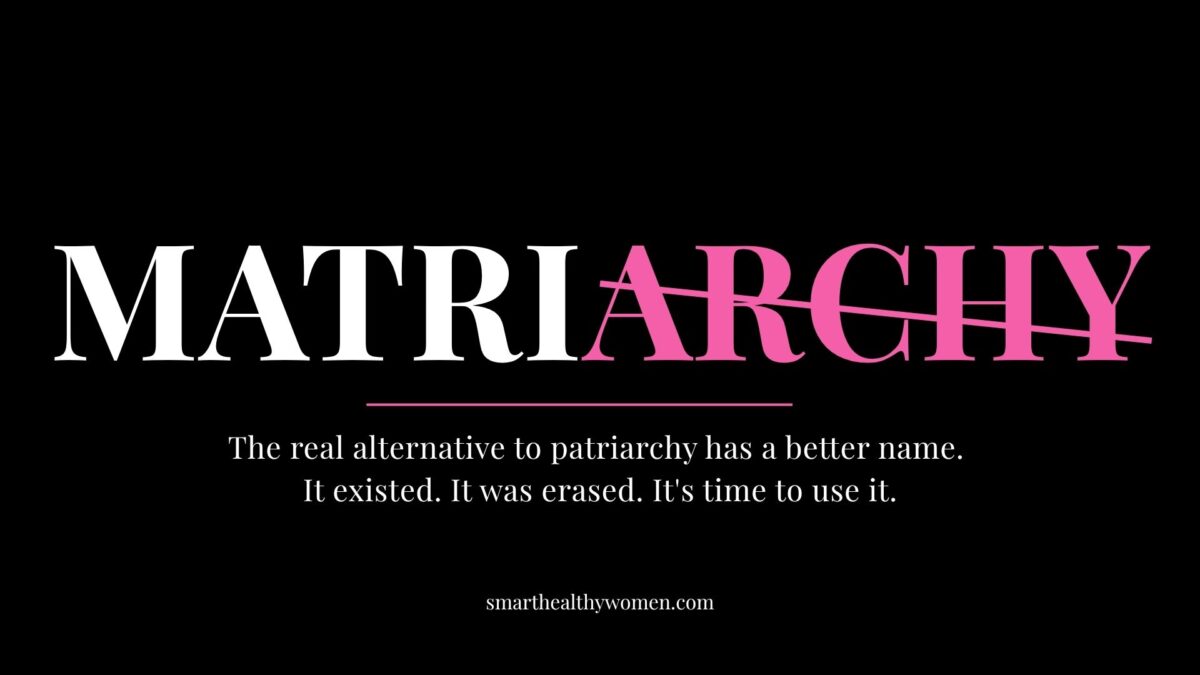
…there's a better term, a documented history, and a reason you weren't taught either.
We’ve been arguing about the wrong word.
When people look for an alternative to patriarchy, “matriarchy” tends to arrive almost automatically, because it feels like the obvious inversion—if one system places men at the centre, then the correction must be to place women there instead, and that symmetry gives the impression that the problem has been addressed.
But the word doesn’t quite hold once you stay with it a little longer, because it isn’t simply describing who is in charge; it is carrying an entire structure with it.
“Matriarchy” sits in the same linguistic family as patriarchy, monarchy, and hierarchy, all of them built on the same root of rule and dominance, and once that becomes visible it becomes difficult to avoid the question that follows, which is whether anything fundamental has actually shifted if the structure itself remains untouched.
It is easy to treat this as a matter of language, as though the issue is only semantic, but the language fixes the frame before anything else has a chance to move, because it assumes that dominance, ranking, and control are not up for negotiation, and that the only meaningful change is who occupies the top position.
And that assumption tends to pass without being examined.
If you replace men with women at the top of a hierarchy, the hierarchy does not disappear, because the logic that produced it is still in place, and the idea that someone must stand above someone else remains intact, which means the system continues to operate as it always has, even if the beneficiaries have shifted.
That is usually where the word begins to feel slightly misaligned, not because it is entirely incorrect, but because it is not quite describing what people think they are pointing toward.
What is being reached for is not simply an inversion, but something that does not rely on that structure at all.
There is a term for it, although it is less comfortable to use and resists being compressed into something neat, which may be part of the reason it has not settled into common language, because we are describing something that has no well-worn shorthand and has not yet been allowed to become familiar, which is why Riane Eisler’s framing of the partnership model becomes useful, particularly as she sets it out in The Chalice and the Blade (1987), where she distinguishes between dominator models of civilisation and those organised around partnership.
A matrilineal egalitarian society describes something closer to what is being reached for, because it names both how lineage is organised and how the system itself operates, with matrilineal referring to inheritance and continuity through the female line, and egalitarian referring to a system that does not organise itself around ranking, even though it is still organised.
This is usually the point where the argument begins to meet resistance, because the suggestion that these kinds of structures have existed—at scale, in stable form—tends to be dismissed as a kind of romantic projection, as though it belongs more to imagination than to history.
But the historical and anthropological record does not support that dismissal.
The Minangkabau in West Sumatra, the Mosuo in Yunnan, the Khasi in northeastern India, and the Haudenosaunee Confederacy in North America each represent different cultural expressions, yet they share a recurring pattern in how lineage, property, and authority are arranged, and while none of these societies are identical or idealised, they do not organise themselves around hierarchy in the way that has come to be treated as inevitable.
The Minangkabau, for example, continue to organise their social and economic life through matrilineal clans, with land and property held by women and passed through the female line, while political decisions are made by consensus rooted in those clan structures, and although Islamic law and colonial influence have exerted pressure over centuries, women’s ownership of land remains a stabilising force that anchors the system in practice rather than in theory.
Among the Mosuo, what is often described as a “walking marriage” system allows women to choose partners without forming permanent cohabiting units, with children raised within the maternal household and men remaining part of their mother’s lineage rather than forming patriarchal family units, which shifts both responsibility and authority away from the nuclear model that is often assumed to be universal.
The Khasi follow a similar matrilineal structure in which the youngest daughter inherits ancestral property and the household remains open to extended kin, including male relatives who do not hold authority within that structure but are not excluded from it, which creates a different balance between inclusion and control than is typically seen in patrilineal systems.
The Haudenosaunee Confederacy extended this logic into governance itself, with clan mothers holding the authority to appoint and remove chiefs and women participating directly in political decision-making, which complicates the assumption that political power has historically been an exclusively male domain.
And once these structures are seen in their actual form, rather than as abstract concepts, the idea that hierarchy is the only viable organising principle becomes harder to maintain.
From there, attention tends to move toward what changed, and the answer, when followed back, is less abstract than it first appears, because it turns on something tangible.
Property.
For most of human history, there was very little that could be accumulated in a way that required structured inheritance, and what people owned moved with them, which meant that social arrangements remained flexible, and in that context tracing lineage through the mother was not ideological so much as practical, because it was observable and did not require enforcement.
Once accumulation becomes possible—through land, livestock, and other transmissible resources—the situation changes, because inheritance introduces a requirement for certainty, and once paternity becomes relevant to inheritance, it creates a problem that does not resolve itself without intervention, a point identified as early as Friedrich Engels in The Origin of the Family, Private Property and the State (1884), and since supported by more recent anthropological and genetic research tracing the shift from matrilineal to patrilineal systems alongside the emergence of transmissible wealth.
That intervention takes the form of control, even if it is not described that way, because controlling women’s movement, sexuality, and reproductive capacity establishes the conditions under which paternity can be secured, and from there the structure follows, not as an inevitable cultural evolution but as an adjustment to the economic conditions that made it necessary.
The second layer is more recent, although it is often presented as ancient, which makes it harder to recognise.
Colonisation did not simply impose political authority; it reorganised social structures in ways that aligned with its own assumptions, and in many African, Indigenous, and Asian societies, systems that had previously allowed for female authority over land, governance, and kinship were displaced, not always through direct prohibition but through recognition, through deciding whose authority would be acknowledged and whose would be ignored, as documented across post-colonial scholarship examining how European legal and religious frameworks were embedded into local governance structures.
Colonial administrations dealt with men, legal systems codified male ownership, and religious frameworks reinforced it, and over time what had been imposed begins to read as inherited, which is a quieter but no less effective form of erasure.
There is a consistency to this pattern that becomes difficult to ignore, because it appears across different regions and different political systems, even when the stated ideologies are not the same.
Where power becomes centralised and hierarchical, structures that do not organise around dominance tend not to survive intact, because they operate on a logic that does not translate easily into systems built on ranking and control, and so they are absorbed, reshaped, or dismantled, a pattern that can be traced not only through colonial expansion but also through internal state consolidation, including dynamics examined by Silvia Federici in Caliban and the Witch (2004), where the suppression of women’s roles in communal economies accompanied the rise of capitalist structures and the enclosure of shared resources.
If these systems have existed, and in some cases continue to exist despite sustained pressure to reorganise them, then the idea that there is no alternative begins to look less like a fact and more like something that has been repeated often enough to feel like one.
Which brings the focus back to the word itself, because “matriarchy” keeps the frame intact and suggests reversal without questioning whether the structure itself is the issue, and that may be why it never quite settles into place.
What is being pointed toward is something that does not depend on hierarchy to function, and while it may not have a single, convenient label, it has existed, it has been disrupted, and in some cases it has endured.
And if something has to be dismantled repeatedly, across time and across cultures, in order to prevent it from continuing, then the more interesting question is not whether it works, but why it keeps being removed.
This piece is part of the ongoing Smart Healthy Women investigation into the systems shaping women's lives and the ones that might replace them. Read more at smarthealthywomen.com.