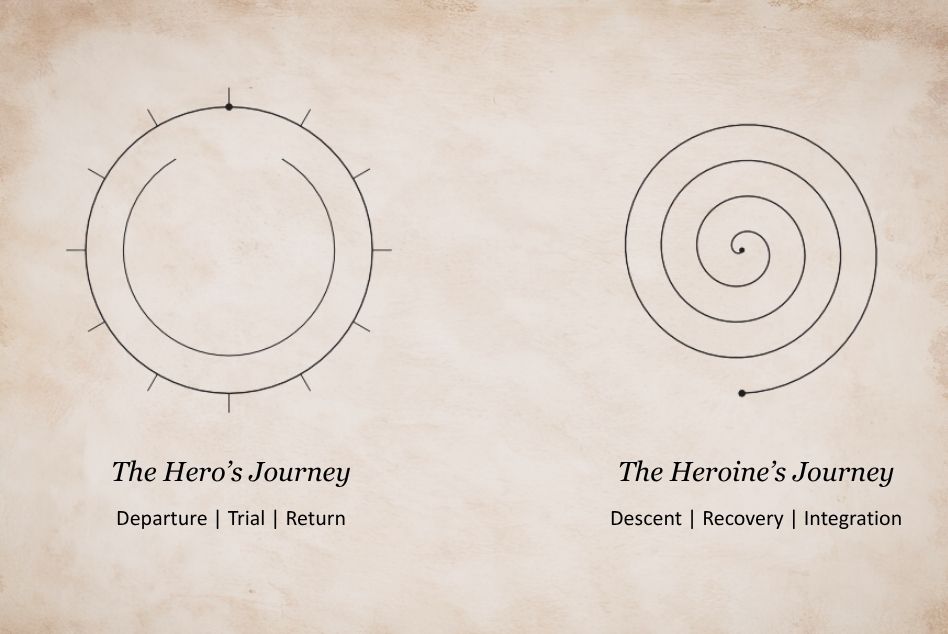
There is a moment in the 1980s that ought to sit closer to the centre of film history than it does. Maureen Murdock, a Jungian analyst who had studied with Joseph Campbell, brought him a question that sounded almost ordinary. If there was a Hero’s Journey, what was the woman’s version?
Campbell’s answer was not complicated. Women didn’t need to make the journey. In the mythological story, the woman was already there. She was the place people were trying to get to.1
That answer does a strange amount of work once you let it sit there for a moment. The most influential mythologist of the twentieth century, the man whose work claimed to have found the universal shape beneath human storytelling, was telling a woman trained in his own methods that women were not the traveller. They were the destination. They were not the subject moving through transformation. They were the place transformation delivered a man to.
Murdock went away and wrote The Heroine’s Journey: Woman’s Quest for Wholeness, published in 1990. The book describes a woman’s search for wholeness in a society that has defined her through masculine values, and yet it never became canonical in the way Campbell’s work did.2 That asymmetry is the whole story in miniature. What looked, at first, like one man’s blind spot was about to become the operating system of an industry.
A Question Joseph Campbell Could Not Answer
Campbell’s The Hero with a Thousand Faces was published in 1949. It proposed the monomyth, a universal pattern of heroic adventure and transformation supposedly running through mythic traditions across the world. Campbell’s own summary is beautifully clean: the hero leaves the world of ordinary life, enters a region of supernatural wonder, wins a decisive victory, and returns with the power to bestow a boon.3 Over time, that pattern was reduced into a working sequence most screenwriters now recognise. The call, the threshold, the trials, the ordeal, the reward, the return.
The Universal Story That Wasn't
The word universal is doing a lot of work here.
Campbell’s major examples were overwhelmingly organised around male figures: Odysseus, Buddha, Christ, knights, sons, warriors, chosen men and exiled boys who leave home, endure trials, win knowledge, and come back changed. When women appear, they tend to appear as functions within that movement. The goddess. The temptress. The mother. The prize. In Campbell’s sequence, “Meeting with the Goddess” and “Woman as the Temptress” are named stages in the hero’s initiation.4 The woman is not absent from the structure. She is present in a way that tells us exactly what the structure thinks she is for.
This is where the problem begins to move from literary theory into culture. Campbell did not present his pattern as one historically located way of telling stories, shaped by the texts he happened to privilege and the assumptions he happened to inherit. He presented it as the story beneath stories. A map of the human psyche. A universal grammar. And once a structure is called universal, disagreement starts to look like failure. The stories that do not fit are treated as underdeveloped, undisciplined, or minor. The people who do not recognise themselves inside the pattern are told they have misunderstood story itself.
From Theory to Template: How Hollywood Industrialised the Monomyth
Then Hollywood found it.
George Lucas has been open about Campbell’s influence on Star Wars. In a 1985 speech honouring Campbell, Lucas said that after many drafts he came across The Hero with a Thousand Faces, and the book gave him the shape his material had been missing. He later called Campbell “my Yoda”.5 Bill Moyers filmed The Power of Myth with Campbell at Skywalker Ranch during the last two summers of Campbell’s life. The series aired in 1988, the year after Campbell died. More than a decade later, in 1999, Moyers returned to Skywalker Ranch to speak with Lucas directly about myth, and Lucas described Star Wars as a conscious attempt to work with old mythological motifs in a contemporary form.6
This is not obscure influence. This is a documented handover.
Star Wars opened in 1977 and became the highest-grossing domestic film of that year by a distance, with Box Office Mojo listing more than $307 million for its 1977 release against $126 million for Smokey and the Bandit.7 The story that had been shaped so deliberately through Campbell’s pattern did what the industry always understands fastest. It made money.
The next step was Christopher Vogler. In the mid-1980s, while working as a story analyst at Walt Disney Pictures, Vogler wrote a seven-page memo called A Practical Guide to The Hero with a Thousand Faces. He later described it as the “legendary seven-pager”, written to turn Campbell’s ideas into a clear set of creative principles and story tools. The memo moved through Disney, then through Hollywood, with Vogler himself describing copies flying through the industry by fax and photocopier, and studio staff using Hero’s Journey stages to outline storyboards.8
By 1985, the memo had reduced Campbell’s sprawling mythic theory into something a development executive could use before lunch. Twelve stages. Act structure. Story problem, diagnosis, correction. The hero starts in an ordinary world, receives a call, refuses it, meets a mentor, crosses a threshold, faces tests, descends, survives death, takes the reward, returns, resurrects, and brings back the elixir.9
This is the part we tend to soften because we prefer our culture to feel organic. But the dominant narrative grammar of global cinema did not simply emerge from the collective unconscious and settle, naturally, over the multiplex. It ran through a pipeline. Campbell publishes the theory in 1949. Lucas applies it at blockbuster scale in 1977. Vogler converts it into an internal studio tool in 1985. That tool spreads through Hollywood and becomes the working grammar by which scripts are read, taught, repaired, and sold.
A theory became a template. A template became an industry standard. And once that happens, the template stops looking like a choice.
Where the Women Went: Function, Not Subject
The trouble for women is not that the Hero’s Journey contains no women. It contains plenty of them. That is part of the trouble. Women appear as the message that begins the quest, the wound that motivates it, the body that tempts the hero away from it, the wisdom that blesses it, the treasure that confirms it mattered. They are structurally useful. They are narratively necessary. They are just rarely the subject.
Marie-Louise von Franz gives a smaller, more intimate version of the same problem in The Feminine in Fairy Tales, and she begins with a paradox. The feminine figures in fairy tales, she writes, are sometimes representations of real women and sometimes projections of the male psyche's interior feminine, its anima — and the difference often turns on the sex of the last person who wrote the story down. The folk tradition that reaches us in print has nearly always passed through that recording hand. The Grimms' sources were largely women, but the editing, moralising, and shaping for publication were done by men.10 By the time a tale reaches the page, the femininity inside it may no longer be a description of women at all. It may be the storyteller's own interior, given feminine form, and handed back to women as if it were theirs.
Writing about “Faithful John“, a tale she reads as reflecting masculine psychology, von Franz notes that there is only one female figure in the story: a pale anima figure, barely present beside the heroic action. A schoolteacher friend gave the tale to a mixed class and asked the children to paint any scene from it. The boys chose heroic and dramatic moments. The girls chose the one feminine figure available to them.
This is the part representation arguments sometimes flatten, although the underlying truth is not flat at all. Children do not only watch stories. They locate themselves inside them. They look for the form that seems to have been made available to them, and then they practise being that. If the only feminine figure in the tale is pale, peripheral, and symbolic, girls may still reach for her because she is the one the story has marked as theirs. The imagination is choosing, but it is choosing from a very small room. And in the older tales, the figure waiting for them inside that room was sometimes not a woman at all. It was a man's interior, returned to them as a mirror they were meant to recognise.11
Vogler’s memo gives us the screen version almost too neatly. In Star Wars, he identifies Princess Leia’s holographic message to Obi-Wan as the Call to Adventure.12 Leia is a woman in distress, yes, but more precisely, she is narrative machinery. Her recorded plea activates Luke’s story. Later in the same memo, Vogler describes the hero’s reward stage as the point where the hero may be reconciled with a woman, often because she is the treasure he has come to win or rescue.13
Leia is sharper than the damsel category allows, which is why audiences have held onto her for so long. She is funny, competent, irritated by male incompetence in ways that still feel fresh. But structurally, in the first film, she is the call, the rescue object, and the royal validation of Luke and Han’s adventure. Across the trilogy she gains more agency, but the deepest relational arc belongs elsewhere. Luke, Han, Vader. Father, son, rival, brother-in-arms. Once Leia is revealed as Luke’s sister, the story tidies away the romantic charge and clarifies what it was always circling: the fate of men, and the terms on which men recognise each other.
The modern workaround has been to put women into the hero slot and call the matter handled.
The Strong Female Character Trap
Katniss Everdeen, Rey, Captain Marvel, and the wave of female-led action franchises that followed are often treated as evidence that the old structure has been repaired because the body inside the structure has changed. But a woman can be placed at the centre of a masculine narrative shape without the shape itself becoming any less masculine. The container is patriarchal. You have just swapped the figurine inside it.
This does not make those characters meaningless. It does not mean audiences were wrong to love them, or that girls were wrong to feel enlarged by seeing a girl hold the bow, the lightsabre, or the impossible power source. Recognition matters. But recognition inside a structure built for someone else has limits. Rey, especially, makes the problem visible because she sits inside the franchise that helped industrialise the pattern. Reviewers and commentators in 2015 often read her arrival as a feminist break for Star Wars, and in representation terms, that reading made sense.14 But structurally, The Force Awakens runs her through a shape so close to Luke’s that the film’s resemblance to A New Hope became one of its central critical conversations.15
A desert orphan. A droid carrying the key. A hidden lineage. A mentor. A call. A death-star-shaped machine. A threshold crossed into destiny. The face changed. The grammar did not.
Murdock's Alternative: Descent, Not Conquest
Murdock’s alternative begins somewhere else. Her Heroine’s Journey does not start with a call that pulls the protagonist away from home into conquest. It begins with a woman who has already separated from the feminine, often because the world has required her to in order to survive or succeed. She identifies with the masculine, gathers allies, passes through trials, receives the boon of success, and then discovers that this success has cost her something essential. The descent begins there. Not from safety into adventure, but from achievement into the recognition that achievement has not made her whole.16
That difference matters. In Campbell’s shape, the hero leaves, conquers, gains, and returns. In Murdock’s, the heroine descends, recovers, heals, and integrates. The abandoned self matters. The body matters. The mother line matters. Relationship is not decoration around the plot. It is the work of the plot.
This is where the word matrifocal helps, as long as we use it carefully. Matrifocal does not mean matrilineal. Matrilineal refers to descent through the mother’s line. Matrifocal describes a story organised around feminine experience and values: relation, care, embodiment, interdependence, repair, the kind of knowledge that does not always arrive as a sword pulled from stone. It is not necessarily softer. Sometimes it is much harder, because it asks characters to stay with what conquest would let them avoid.
Murdock was not alone, although the shelf around her has always been smaller. Kim Hudson’s The Virgin’s Promise, published as a screenwriting book, gives writers a thirteen-beat structure for stories of feminine awakening, organised around a protagonist who begins in conformity, discovers a secret self, gets caught shining, gives up what has kept her small, and forces the kingdom to reorder itself around a fuller truth.17 Gail Carriger’s The Heroine’s Journey approaches the question through pop culture and genre, and makes the contrast unusually clean: the hero’s journey is about individual ascent; the heroine’s journey is about building networks of support. Carriger’s own framing centres the team player over the lone wolf, and treats the heroine’s journey as one of the most popular and neglected narrative structures we have.18
Once You Can See This Shape, It Has Been There All Along
Wild looks, from a distance, like a solitary trek, but the wilderness is not a territory to conquer. It is a descent into grief, memory, the body, and the self that could not be reached through ordinary competence. Whale Rider turns on the restoration of a broken line and the recognition of a girl by a community that has mistaken inheritance for gender. The Color Purple and Beloved recover the self through the recovery of relationship with other women, through witness, memory, and the unbearable labour of becoming real to yourself again. Portrait of a Lady on Fire refuses the male gaze so completely that looking itself becomes the structure. Practical Magic knows, without embarrassment, that sisterhood is not an accessory to the story. It is the load-bearing beam.
And then there is Everything Everywhere All At Once, which is almost a joke played on the industry in plain sight. It arrives wearing the costume of the Hero’s Journey: multiverse action, chosen-one absurdity, martial spectacle, the fate of everything held in a single pair of hands. But the real story is a mother-daughter rupture and the painful, ridiculous, stubborn work of repair. The genre noise is loud enough to get the film through the door. The thing that makes people cry is matrifocal.
The cleanest mainstream example is still Frozen. In 2013, Disney released a film that broke the monomyth in front of everyone and was rewarded for it. The act of true love that saves the story is not romantic. It is not a prince, a kiss, or a heroine being chosen by the right man. It is sisterhood. The film went on to make roughly $1.28 billion worldwide.19
A generation of small girls watched a story in which the central relationship was between sisters, the false romantic solution was exposed as false, and the resolution came through love that did not require male selection. The industry did learn from this, in the way industries learn from anything that makes money. It made Frozen II. It did not, more broadly, let the structural lesson generalise.
That is the part we keep missing. Audiences are not confused by alternative shapes. They are not allergic to stories organised around care, repair, descent, or collective survival. They recognise them immediately, often with relief. What has been missing is not appetite. It is permission.
Widening the Shelf
Narrative is how we rehearse what is possible. Forty years of being told that meaningful change comes from one exceptional individual leaving home, defeating an antagonist, and returning with the prize has consequences. It trains the imagination towards rescue, conquest, and the lone figure who will go where ordinary people cannot. It makes collective work look narratively weak because it is slow, relational, compromised, and often invisible while it is happening.
That is poor preparation for the kind of change most of us actually need.
The work is not to keep feeding women into the monomyth and calling it progress. We have tried that. It gives us hollow blockbusters and even hollower politics, full of exceptional women proving they can survive the same machinery that diminished everyone else. The deeper work is to widen the shelf of shapes we recognise as story at all. To teach the Heroine’s Journey beside the Hero’s. To name the matrifocal tradition that has always existed and has always been treated as secondary. To notice, when we sit down with a film, a novel, or a news report, what shape we are being handed, and whose interests that shape serves.
Because the cost of the patriarchal monomyth is not only borne in the films we watch. It is borne in the wars we accept, the leaders we wait for, the rescues that never come, and the quieter forms of repair we fail to recognise because no one rides home alone at the end carrying a sword.
Footnotes and Research References
- Maureen Murdock recounts Campbell’s response in relation to the origin of her model. See “Maureen Murdock’s Heroine’s Journey Arc”, Heroine Journeys, which gives the 1983 context and the quoted wording: https://heroinejourneys.com/heroines-journey/. ↩
- Maureen Murdock, The Heroine’s Journey: Woman’s Quest for Wholeness, Shambhala, 1990. Publication details are listed by the Internet Archive: https://archive.org/details/heroinesjourney00murd. Shambhala describes the book as a woman’s search for wholeness in a society defined by masculine values: https://www.shambhala.com/the-heroine-s-journey-3034.html. ↩
- Joseph Campbell, The Hero with a Thousand Faces, Bollingen, 1949. The Joseph Campbell Foundation summarises the book’s monomyth claim and quotes Campbell’s core pattern of departure, victory, and return: https://www.jcf.org/learn/joseph-campbell-heros-journey/. ↩
- The Joseph Campbell Foundation’s overview names the monomyth as a universal pattern and describes the stages and variations, including sacred marriage, atonement with the father, and the goddess/woman motifs within the hero’s initiation: https://www.jcf.org/learn/joseph-campbell-heros-journey/. ↩
- Lucas’s 1985 speech honouring Campbell is quoted by the Joseph Campbell Foundation, including Lucas’s description of finding The Hero with a Thousand Faces after many drafts and his “my Yoda” line: https://www.jcf.org/learn/star-wars. ↩
- Bill Moyers, “The Mythology of Star Wars with George Lucas”, BillMoyers.com, 1999: https://billmoyers.com/content/mythology-of-star-wars-george-lucas/. ↩
- Box Office Mojo, “Domestic Box Office For 1977”, ranking Star Wars: Episode IV: A New Hope first for the year with $307,263,857: https://www.boxofficemojo.com/year/1977/. ↩
- Christopher Vogler describes the memo’s origins and its circulation through Disney and Hollywood in “The Writer’s Journey”, Chris Vogler’s Writer’s Journey Blog: https://chrisvogler.wordpress.com/category/christopher-vogler/the-writers-journey/. See also Vogler’s introduction to “The Memo That Started It All”: https://www.ilchiefs.org/vogler-7-page-memo. ↩
- Christopher Vogler, “A Practical Guide to Joseph Campbell’s The Hero with a Thousand Faces”, 1985. The memo’s twelve stages are reproduced in “The Memo That Started It All”: https://www.ilchiefs.org/vogler-7-page-memo. ↩
- On the female-source/male-editor pattern in the Grimms' tales, see Jack Zipes, The Brothers Grimm: From Enchanted Forests to the Modern World, second edition, Palgrave Macmillan, 2002, which documents that the Grimms' major storytellers included Dorothea Viehmann and the young women of the Wild and Hassenpflug families, who met in Kassel storytelling circles to relate tales they had heard from nursemaids, governesses, and servants: https://link.springer.com/book/10.1007/978-1-137-09873-3. On the editorial reshaping of those tales by Wilhelm Grimm across successive editions — the moralising, sanitising, and bourgeois reframing — see Maria Tatar, The Hard Facts of the Grimms' Fairy Tales, Princeton University Press, 1987 (expanded edition 2003): https://press.princeton.edu/books/paperback/9780691182995/the-hard-facts-of-the-grimms-fairy-tales. ↩
- Marie-Louise von Franz, The Feminine in Fairy Tales, revised edition, Shambhala, 1993. The paraphrased passage refers to von Franz’s discussion of “Faithful John”, supplied from the book text. Publication details and publisher description are available through Penguin Random House/Shambhala: https://www.penguin.com.au/books/the-feminine-in-fairy-tales-9780834840812. ↩
- Vogler identifies Princess Leia’s holographic message to Obi-Wan as the Call to Adventure in the 1985 memo: https://www.ilchiefs.org/vogler-7-page-memo. ↩
- Vogler’s memo describes the reward stage as the point where the hero may be reconciled with a woman, often because she is the treasure he has come to win or rescue: https://www.ilchiefs.org/vogler-7-page-memo. ↩
- Jessica Valenti, “Star Wars is a game-changer: awakening the feminist force in little girls everywhere”, The Guardian, 30 December 2015: https://www.theguardian.com/commentisfree/2015/dec/30/star-wars-is-a-game-changer-awakening-the-feminist-force-in-little-girls-everywhere. ↩
- Darren Franich, “Star Wars: The Force Awakens: Similarities to A New Hope”, Entertainment Weekly, 19 December 2015: https://ew.com/article/2015/12/19/star-wars-force-awakens-new-hope-similarities/. ↩
- Murdock’s model is summarised in “Maureen Murdock’s Heroine’s Journey Arc”, Heroine Journeys: https://heroinejourneys.com/heroines-journey/. See also Shambhala’s description of The Heroine’s Journey: https://www.shambhala.com/the-heroine-s-journey-3034.html. ↩
- Kim Hudson, The Virgin’s Promise: Writing Stories of Feminine Creative, Spiritual and Sexual Awakening, Michael Wiese Productions, 2010. Hudson describes the thirteen-beat pattern on her author site: https://kimhudsonauthor.com/about-1. Publisher description: https://mwp.com/product/the-virgins-promise/. ↩
- Gail Carriger, The Heroine’s Journey: For Writers, Readers, and Fans of Pop Culture, 2020. Carriger’s own book page frames the heroine’s journey as a distinct structure and “one of the most popular yet neglected narratives of our time”: https://gailcarriger.com/books/hj/. For the networked structure, see Plottr’s summary of Carriger’s model: https://plottr.com/heroines-journey-plot-template/. ↩
- Box Office Mojo lists Frozen at $1,284,879,663 worldwide: https://www.boxofficemojo.com/title/tt2294629/. ↩